
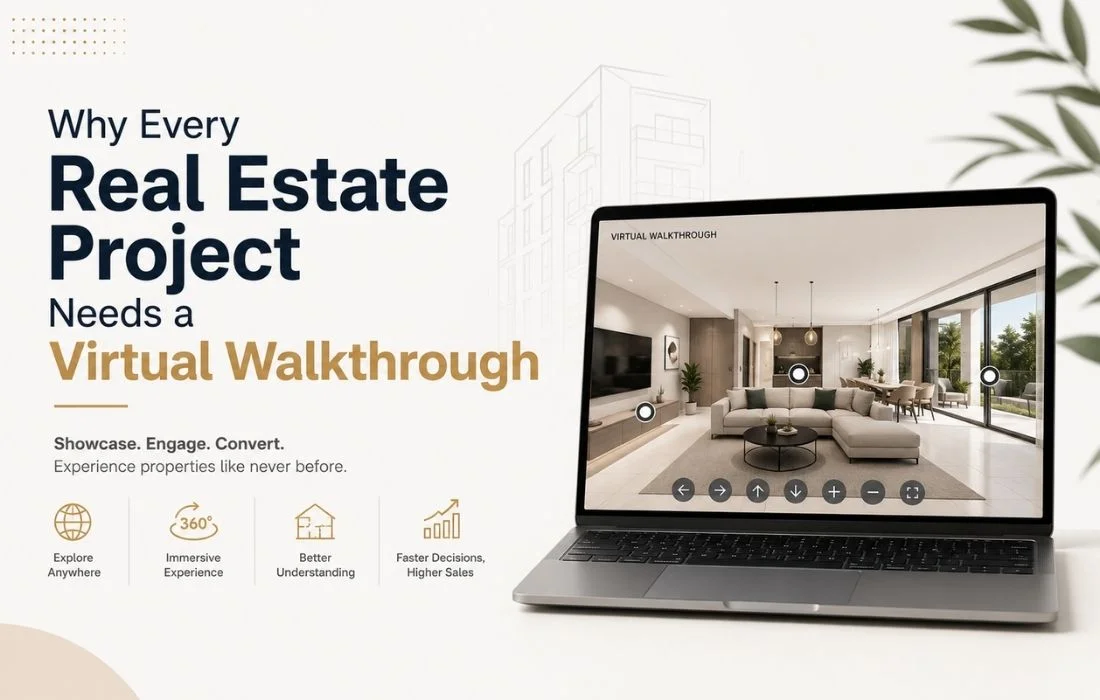
The real estate industry has evolved dramatically over the past decade. Today’s property buyers expect convenience, transparency, and immersive experiences before making a purchase decision. Traditional brochures, photographs, and even video tours are no longer sufficient to capture the attention of modern buyers who want to explore properties from the comfort of their homes.
This is where a Virtual Walkthrough becomes a game-changing marketing tool. Whether it is a residential apartment, luxury villa, commercial complex, office space, or township project, it allows potential buyers to experience a property digitally as if they were physically present.
As competition continues to increase in the real estate market, developers, builders, and real estate agencies are embracing advanced technologies to improve customer engagement and accelerate sales. A Real Estate Virtual Tour has become one of the most effective solutions for achieving these goals.
What Is a Virtual Walkthrough?
A Virtual Walkthrough is an interactive digital representation of a property that allows users to navigate through different areas using their computer, tablet, smartphone, or VR headset.
Unlike static photographs, a Property Virtual Tour offers a realistic and immersive experience where users can:
- Explore rooms and spaces from multiple angles
- Navigate freely through the property
- View detailed interiors and layouts
- Understand room dimensions and flow
- Experience the overall ambiance of the project
Modern solutions such as the 360 Degree Virtual Tour take this experience even further by providing complete panoramic views of the property.
The Growing Importance of Virtual Walkthroughs in Real Estate
The buying journey has become increasingly digital. Before scheduling a site visit, buyers often spend considerable time researching projects online.
According to the National Association of Realtors, a significant percentage of home buyers begin their property search on the internet. This shift has made digital presentation tools essential for real estate success.
It helps bridge the gap between online research and physical visits by offering a highly engaging experience that traditional marketing materials cannot provide.
1. Creates an Immersive Buyer Experience
One of the biggest advantages of a Virtual Property Showcase is its ability to create an immersive experience.
Photos only capture selected angles, while videos follow a predetermined path. In contrast, it allows buyers to control their exploration.
They can:
- Move room to room
- Zoom into specific details
- View architectural features
- Explore amenities
- Understand the overall layout
This level of interaction significantly improves buyer engagement.
2. Attracts More Qualified Leads
Many real estate inquiries come from individuals who are still exploring options and may not be ready to buy.
An Interactive Property Tour helps filter serious prospects from casual browsers. Since buyers can thoroughly examine the property online, those who proceed to contact the sales team are typically more informed and interested.
This results in:
- Higher-quality leads
- Better conversion rates
- Reduced sales effort
- Faster deal closures
3. Expands Reach Beyond Geographic Boundaries
One of the major challenges in real estate marketing is reaching buyers who live in different cities or countries.
A Real Estate Virtual Tour allows prospective buyers to explore a project regardless of location.
This is especially beneficial for:
- NRI buyers
- International investors
- Relocating professionals
- Out-of-state property seekers
Instead of arranging multiple site visits, buyers can evaluate properties remotely and make informed decisions.
4. Enhances Real Estate Marketing Campaigns
Digital marketing has become the backbone of modern property promotion.
A virtual walkthrough can significantly improve the performance of:
- Website campaigns
- Social media advertisements
- Email marketing
- Google Ads
- Property listing platforms
When users spend more time interacting with a property page, engagement metrics improve, which can positively impact marketing performance.
Developers and real estate businesses can enhance their property marketing by adopting interactive virtual walkthrough solutions that deliver immersive property experiences, engage buyers more effectively, and support faster, more informed purchasing decisions.
5. Builds Buyer Confidence and Trust
Property purchases involve significant financial commitments.
Buyers want complete transparency before investing.
A 360 Degree Virtual Tour allows potential customers to inspect spaces thoroughly, reducing uncertainty and building trust.
Unlike edited photos that may only highlight attractive areas, this provide a more comprehensive and realistic view of the property.
This transparency increases buyer confidence and encourages faster decision-making.
6. Reduces Unnecessary Site Visits
Physical site visits require time and coordination from both buyers and sales teams.
By offering a detailed Property Virtual Tour, buyers can shortlist projects before scheduling an in-person visit.
This helps developers:
- Save resources
- Improve sales efficiency
- Focus on serious prospects
- Reduce operational costs
Sales representatives can spend more time engaging with high-intent buyers rather than conducting repetitive property tours.
7. Accelerates Sales Cycles
The traditional property buying process can be lengthy due to multiple visits and extensive evaluations.
Virtual walkthroughs streamline the decision-making process by giving buyers immediate access to detailed property information.
As a result:
- Buyers make faster decisions
- Queries are reduced
- Follow-up cycles become shorter
- Sales close more quickly
This makes them a powerful asset for improving Real Estate Sales.
8. Showcases Under-Construction Projects Effectively
Marketing under-construction properties can be challenging because buyers cannot fully visualize the finished product.
They help bridge this gap by using architectural renderings and 3D visualization.
Developers can showcase:
- Future interiors
- Amenities
- Landscaping
- Clubhouses
- Commercial spaces
This enables buyers to understand the project’s potential long before completion.
9. Provides a Competitive Advantage
Many real estate projects still rely heavily on traditional marketing materials.
Offering an advanced Interactive Property Tour immediately differentiates a project from competitors.
Projects featuring them often appear:
- More innovative
- More transparent
- More customer-focused
- More technologically advanced
These perceptions can significantly influence buyer preferences.
10. Improves Website Engagement and SEO Performance
A virtual walkthrough encourages visitors to spend more time on a website.
Longer engagement often leads to:
- Lower bounce rates
- Increased page views
- Better user experience signals
- Higher lead generation opportunities
These factors can contribute positively to search engine visibility and overall digital marketing performance.
Buyers, investors, and businesses seeking commercial leasing opportunities, office spaces, retail outlets, or investment properties can benefit from exploring commercial real estate investment and leasing platforms to discover suitable properties, stay informed about market trends, and identify locations that support their business and investment objectives.
How Coworking Spaces are Empowering Freelancers and Startups to Grow and Thrive
11. Supports VR and Future Technologies
Virtual reality is becoming increasingly popular in the real estate industry.
Modern walkthroughs can be integrated with VR headsets, creating highly immersive experiences that closely replicate physical visits.
For those searching for their ideal home or exploring premium residential opportunities, luxury residential property platforms can serve as a valuable resource for discovering homes that combine modern comforts, quality amenities, and an elevated lifestyle.
As technology advances, these will continue to play a crucial role in property marketing strategies.
Key Features of an Effective Virtual Walkthrough
A successful virtual walkthrough should include:
- High-resolution panoramic views
- Smooth navigation
- Interactive hotspots
- Floor plan integration
- Mobile compatibility
- VR support
- Property information tags
- Fast loading speed
These features ensure a seamless and engaging user experience.
The Future of Real Estate Marketing
The future of real estate marketing is digital, interactive, and customer-centric.
Buyers increasingly expect instant access to information and immersive experiences. Virtual walkthroughs satisfy these expectations while helping developers market properties more effectively.
As competition intensifies, businesses that embrace innovative technologies will have a stronger advantage in attracting buyers and generating sales.
They are no longer a luxury—they are becoming an essential component of modern real estate marketing strategies.
Your Expert Guide to Commercial Investment & Leasing in India
Conclusion
A Virtual Walkthrough has transformed the way properties are marketed, explored, and sold. It offers an immersive experience that helps buyers make informed decisions while enabling developers to attract qualified leads, reduce unnecessary site visits, and accelerate sales.
Whether showcasing completed developments or promoting under-construction projects, a Real Estate Virtual Tour provides unmatched convenience and engagement. As digital expectations continue to rise, integrating a 360 Degree Virtual Tour into your marketing strategy is one of the smartest investments a real estate business can make.
Companies that leverage virtual walkthrough technology today will be better positioned to meet buyer expectations, improve customer experiences, and achieve long-term success in an increasingly competitive real estate market.
Frequently Asked Questions (FAQs)
1. What is a virtual walkthrough in real estate?
A virtual walkthrough is an interactive digital experience that allows buyers to explore a property remotely using a computer, smartphone, tablet, or VR headset. It provides a realistic view of the property’s layout, interiors, and features before an in-person visit.
2. How is a virtual walkthrough different from a video tour?
A video tour follows a fixed path chosen by the creator, while a virtual walkthrough allows users to navigate freely and explore the property at their own pace. This creates a more engaging and immersive viewing experience.
3. Why are virtual walkthroughs important for real estate projects?
This help developers showcase properties more effectively, attract qualified buyers, and build trust through greater transparency. They also reduce unnecessary site visits and speed up the decision-making process.
4. Can it help sell under-construction properties?
Yes. By using 3D visualization and interactive walkthroughs, developers can present the future appearance of under-construction projects, helping buyers better understand the design, amenities, and overall vision before completion.
5. Do virtual walkthroughs improve lead generation?
Absolutely. Buyers who explore a property through a virtual walkthrough are often better informed and more interested, resulting in higher-quality leads, improved conversion rates, and more productive sales interactions.
6. Are they suitable for commercial real estate?
Yes. They are widely used for office spaces, retail outlets, commercial complexes, warehouses, and leasing properties, allowing businesses and investors to evaluate spaces remotely before arranging physical visits.
7. Can they be viewed on mobile devices?
Most modern virtual walkthroughs are fully responsive and can be accessed on smartphones, tablets, laptops, and desktops. Many solutions also support virtual reality headsets for a more immersive experience.
8. How do they benefit real estate marketing?
They enhance digital marketing campaigns by increasing user engagement, improving website retention, and providing buyers with an interactive experience that stands out from traditional photos and brochures.
9. What features should a high-quality virtual walkthrough include?
A quality virtual walkthrough should offer high-resolution panoramic views, smooth navigation, interactive hotspots, floor plan integration, mobile compatibility, VR support, and fast loading speeds to ensure a seamless user experience.
10. Is investing in a virtual walkthrough worthwhile for real estate developers?
Yes. As buyers increasingly expect digital-first experiences, virtual walkthroughs provide a competitive advantage by improving customer engagement, supporting faster sales decisions, and strengthening overall property marketing efforts.


